Airspace Modernisation and Change
Whilst UK airspace is safe, the UK airspace structure is widely recognised as being inefficient. In addition, new airspace users such as drones need to be accommodated.
The BGA;
- Recognises the need to protect the public who are travelling in commercial air transport aircraft
- Supports the need for carefully considered airspace modernisation that reasonably addresses the specific needs of all airspace users including equitable access to airspace.
- While recognising that commercial rather than environmental considerations prioritise their activity, supports the need for commercial air transport and business aviation operations to be more efficient, including steeper climbs and descents, reducing fuel burn, reducing noise impacts.
- Does not automatically oppose all airspace change proposals – each is carefully considered on its merits
To ensure that the needs of all airspace users are reasonably met and to restore balance, the BGA believes that the way lower airspace is designed and managed needs to change. A strategic approach needs to be adopted in partnership with all airspace users, with a more assertive and effective CAA overseeing compliance with newly and carefully developed modern airspace policies and standards that are fit for purpose. The report that followed the Lord Kirkhope inquiry into the UK’s lower airspace provides useful direction.
The BGA is working towards those aims with all other stakeholders. For more detail see Consultations and Representation.
Airspace Modernisation
A Government directed Airspace Modernisation Strategy (AMS) aims to redevelop UK airspace. You can read more from the CAA here.
NERL (part of NATS plc, an international corporation that provides air navigation services including for all en-route upper airspace) has already started to establish modernised upper airspace above 7000′.
Lower airspace, ie below 7000′, is more of a problem. Unlike in most other countries, in the UK there are numerous Air Navigation Service Providers (ANSPs) who are all keen to meet the financial needs of their airport owners and/or their shareholders. As a result, many of the airports are in competition with each other and resources can be limited. That results in significant challenges when trying to make the UK’s airspace more efficient.
In a Government driven attempt to get the airports to contribute effectively to airspace modernisation through co-ordinated airspace changes, NATS (En Route) plc (NERL) is from late 2026 responsible for providing a UK Airspace Coordination Service (UKACS), which replaces the masterplan role previously undertaken by the now disbanded Airspace Change Organising Group (ACOG). NERL’s role, as the provider of the UKACS, is to facilitate coordination of certain strategically interdependent cluster airspace change proposals (ACPs).
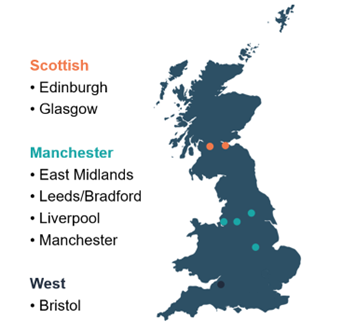
Image: UKACS clusters, i.e. Scottish TMA, Manchester TMA and West TMA.
With the aim of making cluster airspace change implementation more efficient, the UK Airspace Design Service (UKADS) has been formed (2026) and is operated by NERL. The UKADS role is to ‘coordinate and sponsor future airspace changes to deliver the holistic, modernised airspace design envisaged by the Airspace Modernisation Strategy’. Initially, the UKADS will be focussed on future London TMA cluster airspace changes. In the much longer term, there is an ambition to extend UKADS remit to all ACPs.
In late 2026, it is not yet clear how UKADS and UKACS will be overseen in terms of impartiality.
Airspace change
The BGA is involved with most ACPs that impact on gliding. Where possible, we respond alongside or as a part of a GA Alliance response.
Club airspace officers are encouraged to get involved with tracking potential airspace issues that may impact their club’s operations.
Airspace change proposals under CAP725 can be viewed here.
Airspace change proposals under CAP1616 can be viewed here.
The CAA airspace department can be contacted here.
What is Performance Based Navigation?
Performance-based navigation is a concept developed by ICAO that moves aviation away from the traditional use of aircraft navigating by ground-based beacons to a system more reliant on airborne technologies, utilising area navigation and global navigation satellite systems. Its use enhances navigational accuracy. For more information, see Annex B of the Air Navigation Guidance 2017.
How will the AMS changes impact general aviation including gliding?
What’s changing?
- The AMS is currently forecast to continue through to 2050 – a long period of change.
- Performance Based Navigation (PBN) – modernised RNAV procedures, with possible reduced volumes of class G near controlled airspace
- Moving noise around by increasing numbers of en-route options in any given direction, resulting in increased volumes of controlled airspace.
- Electronic Conspicuity (EC) – a likely near-future EC carriage mandate in support of drone integration
- UAS Traffic Management (UTM) & Detect and Avoid (DAA) in support of drones
Club and pilot actions?
- Take part in consultations to ensure GA voice is heard. Engage with BGA where support requested.
- Watch for and understand new airspace structures in NOTAMs and charts.
- Evaluate ADS-B/EC devices; plan installation budget.
- Learn how to use EC in-flight.
- Keep current with CAA policy developments.
- Consider obtaining a radio licence (FRTOL).
Stay informed – follow:
- CAA website: www.caa.co.uk/ams
- NOTAMs & AIP updates
- BGA e-news and this website