Sailplane Pilot Licence (SPL) Training Course
SPL Training Course
v1.6 August 2025
The BGA training organisation supports compliance with Part-Sailplane Flight Crew Licensing (SFCL).
All SPL training is carried out in accordance with this training course programme and BGA training organisation requirements, which must be read and understood by instructors.
Contents:
- Safety
- Threat and Error Management
- The SPL course
- Theoretical knowledge
- Flight instruction
- Delivering the flying training
- Recording progress
- First solo and pilot motivation
- Authorisation and supervision of solo flying by student pilots
- SPL course completion
- Skill test
- Applying for an SPL
- Resources and documents
1. Safety. The BGA office is responsible for publication of the BGA Safety Management System (SMS) manual, which is available on the BGA members website (search Safety Management System).
Clubs are responsible for the safety of all training carried out at and from their site and for compliance with club and BGA incident and accident reporting requirements.
Instructors and student pilots must be directed to published club safety and operating requirements, which should be explained and referred to during training.
The student pilot should be encouraged to openly discuss safety related issues experienced during training in the context of a ‘just culture’.
2. Threat and Error Management (TEM). Reference to TEM must be included for all flight exercises. As the training progresses, the student pilot should be taught to and be expected to consider TEM as part of their pre-flight preparation, including during solo flight under supervision. Note: distraction and/or interruption are significant hazards.
3. The SPL Course. Before being accepted for training, an applicant should be informed about the medical requirement that must be obtained before solo flying is permitted.
The SPL flight instruction syllabus includes the principles of threat and error management (TEM) and covers:
- pre-flight operations, including verifying mass and balance, aircraft inspection and servicing, airspace and weather briefing
- rigging of sailplanes, including control surface connections
- aerodrome and traffic pattern operations, collision avoidance precautions and procedures
- control of the aircraft by external visual reference
- flight at high angle of attack (critically low air speeds), recognition of, and recovery from, incipient and full stalls and spins
- flight at critically high air speeds, recognition of, and recovery from spiral dive
- normal and crosswind take-offs in respect of the different launch methods
- normal and crosswind landings
- short field landings and out-landings: field selection, circuit and landing hazards and precautions
- cross-country flying using visual reference, dead reckoning and available navigation aids
- soaring techniques as appropriate to site conditions
- emergency actions
- considerations for soaring at high altitudes; and
- compliance with air traffic services procedures and communication procedures.
This training course includes the following theoretical knowledge and flight instruction:
4. Theoretical knowledge covers:
- air law
- human performance
- meteorology
- communications
- principles of flight
- operational procedures
- flight performance and planning
- aircraft general knowledge related to sailplanes
- navigation
The theoretical knowledge should be integrated with the flight training and the examination taken as experience of applying theoretical knowledge to flight training is gained. The Part SFCL theoretical knowledge topics are detailed at AMC1 SFCL.130 SPL.
Read about SPL theoretical knowledge and exams (including crediting for other experience) at SPL Theoretical Knowledge and Examinations
5. Flight instruction of at least 15 hours is required including at least:
- 10 hours of dual flight instruction (at least seven of which must be in sailplanes excluding TMGs)
- two hours of supervised solo flight time
- 45 launches or take-offs and landing
Three of the flight instruction hours in sailplanes which must be in sailplanes excluding TMGs must be dual flight instruction.
**Other flying experience may only be credited (SFCL.130 (b)) where the BFCL or FCL licence / rating for another category of aircraft is valid complete with valid medical certificate or PMD. A simple annotation to the effect that the applicant holds the licence made on the applicants training records should be sufficient. This should be verified to the Club CFI/Head of Training by presenting the licence being used as a credit.**
For initial SPL training (that does not include training for TMG privileges) TMGs can be used for a maximum of 8 hours. It follows that all training exercises in this course must be completed without any TMG-specific manoeuvres.
Gliding training in a TMG can be provided by FI(S) certificate holders who do not hold the TMG instructional privileges as specified in point SFCL.315(a)(4), provided that the instructor occupies the pilot seat from which all PIC functions can be executed and holds valid SPL TMG privileges. Out-landing training in a TMG may only be provided by an FI(S) who has been specifically trained to do so.
Example:
Six hours dual flight training in a K21, and four hours dual flight training in a TMG, and five hours solo under supervision in a K21 or single seat glider.
The Part SFCL flight training exercises are detailed at AMC2 SFCL.130 SPL.
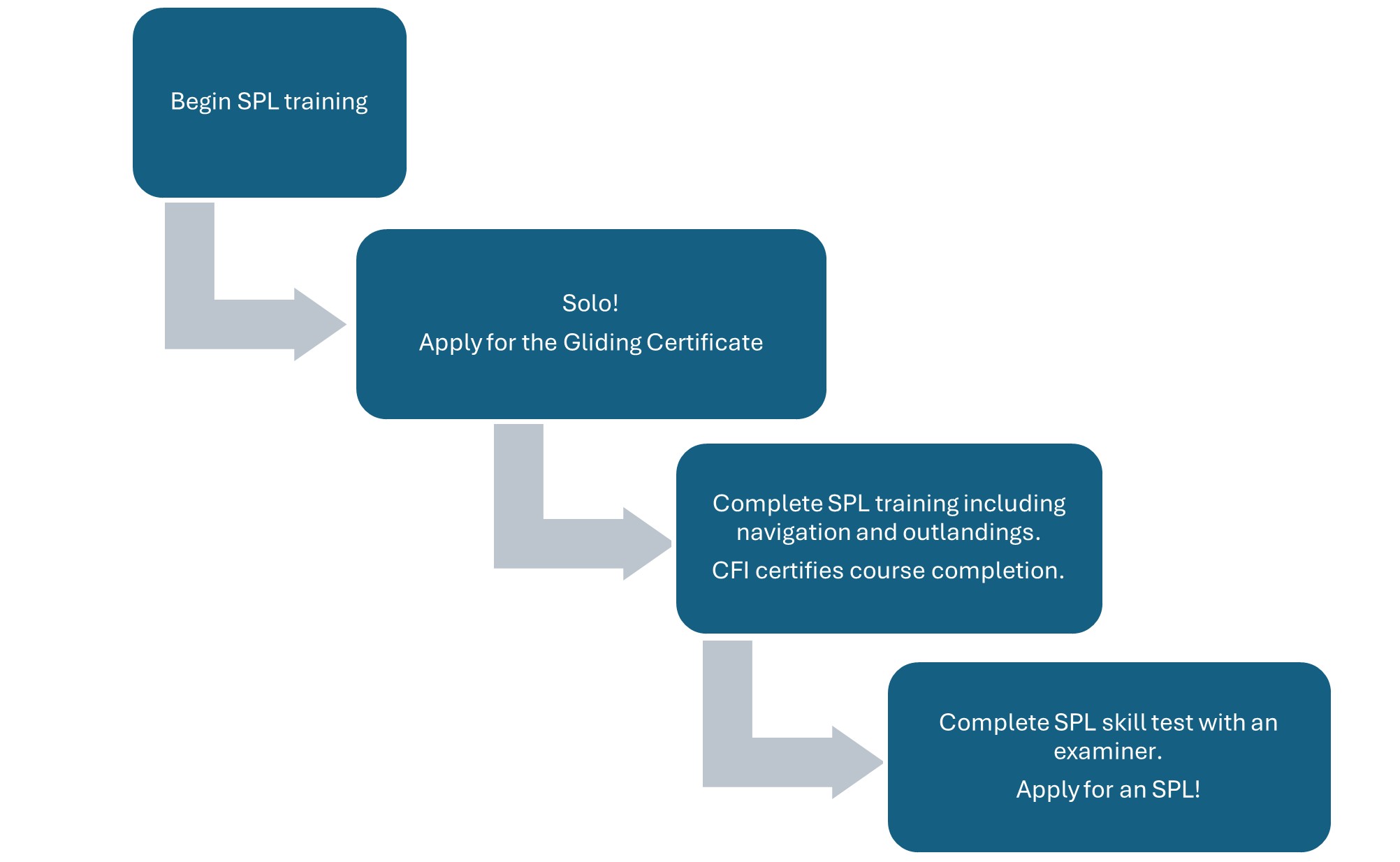
6. Delivering the flying training. The order of exercises detailed on the student pilot record card (see recording progress below) should be used primarily as a broad instructional sequencing guide; the demonstrations and practices need not necessarily be given in the order listed. The actual order and content will depend upon the following interrelated factors:
- the applicant’s progress and ability
- the weather conditions affecting the flight
- the flight time available
- the instructional technique considerations
- the local operating environment; and
- the applicability of the exercises to the sailplane type.
At the discretion of the instructors, some of the exercises listed in the student pilot training record card may be combined and some other exercises may be completed in several flights.
Learning to operate the required systems and equipment, including audio variometer, radio, and electronic conspicuity device should be introduced progressively as the student pilot develops the necessary capacity.
7. Recording progress. After each training flight or group of training flights, the FI(S) is expected to update the hard copy or electronic student pilot SPL training record card, with related comments usually included in the student pilot’s logbook. Launches and hours should be recorded in the candidate’s logbook based on club records.
The BGA recommended student pilot SPL training record card is available as a download – see link below. The SPL training record card is designed to provide a practical breakdown of the required exercises. It should be retained at the club site where training is taking place (i.e. not held remotely by the student pilot). Note: a separate BGA ground training record card is also available.
The FI(S)’s should continuously assess student pilot progress. The CFI should maintain a broad overview of student progress and give advice where necessary.
Examination theoretical knowledge instruction (for example video briefings, lectures, self-study) should be documented using the training record card or an electronic equivalent. Examination results are recorded and certified on the SPL application form.
Where a candidate moves to another club during training, the training record card should be copied and retained by the original club. The original student pilot training record card should be transferred to the candidate’s ‘new’ club via the CFI’s.
Completed SPL training records and a copy of the signed completion certificate should be retained by the club in hard copy or electronic format.
8. First solo and student pilot motivation. Full spin training is optional prior to solo (an example might be when learning to glide where spin training is unavailable) and must be completed prior to the SPL skills test.
Before allowing applicants to undertake their first solo flight, the FI(S) should ensure that they can operate the required systems and equipment, including audio variometer, radio, and electronic conspicuity device.
The minimum age for solo is 14 and the pilot must meet the medical requirement to fly as pilot in command.
Following their first solo, the candidate should be encouraged by the supervising FI(S) to:
- apply for their BGA Gliding Certificate – this provides recognition, motivation, engagement with the BGA, and access to sporting badge claims, etc.
- be made aware of the need to seek instructor authorisation for further solo flight
- develop their experience flying solo under supervision, including for example obtaining FAI silver height and duration badges (which are added to the solo certificate)
- complete the remaining SPL training course exercises
- make themselves aware of the content of the SPL skills test
Before a first planned solo soaring flight, the relevant soaring training should have been completed.
9. Authorisation and supervision of solo flight by student pilots. Student pilots are likely to carry out a significant amount of solo flying during SPL training. Instructors are reminded of SFCL.125 SPL regarding authorisation and supervision of solo flight by a student pilot.
Where authorisation of solo flight is required, the BGA ‘solo flight authorisation form’ supports compliance with SFCL.125(a).
10. SPL course completion. Once training has been completed, the student pilot should be able to:
- complete all manoeuvres with smoothness and accuracy
- exercise good judgement and airmanship, and
- apply aeronautical knowledge and regulations as currently apply, and
- at all times maintain control of the sailplane such that the successful outcome of a procedure or manoeuvre in never seriously in doubt.
On completion of training, the CFI is to check the student pilot’s training record including logbook recorded experience and complete the SPL course completion certificate CFI declaration. The student pilot is to declare on the SPL course completion certificate that they are satisfied that they have completed the certified training.
11. Skill test. Following course completion, an SPL skill test should be arranged with a Flight Examiner (Sailplanes).
12. Applying for an SPL. On successful completion of the skill test, an SPL application form must be submitted to the BGA for subsequent licensing action by the CAA.
13. Resources and documents.
BGA recommended student pilot SPL training record card.
Solo flight authorisation form.
BGA Solo/Gliding Certificate application form
The ‘BGA Student Pilot Manual‘ – all student pilots (and instructors) should own a copy.
Specific guidance for exercise 16 out-landings. More field landing information can be viewed here.
Specific guidance for exercise 17 navigation.
Theoretical knowledge examination resources.
Printable SPL course programme including course completion certificate.